|
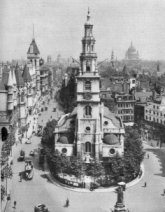
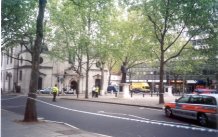
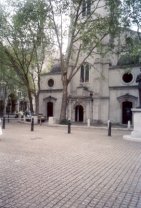
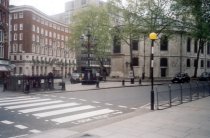
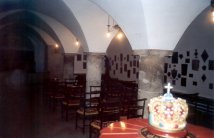
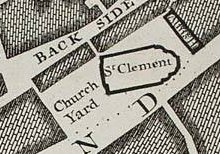
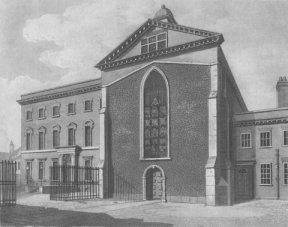
Existing grounds St. Clement Danes Churchyard. The ground around the church is much reduced in size and paved over. The crypt has been cleared and opened as a chapel. Burial place of Anne Donne, Wife of John Donne, d.1617. Also, supposedly, of Harold Harefoot, King of the English, d. 1040. This is now 1 acre in extent, having been curtailed, when the Strand was altered. It is closed. (Holmes) ST. CLEMENT'S CHURCH, Strand. - There is a vault under this church called the "Rector's Vault," the descent into which is in the aisle of the church near the communion table, and when opened the products of the decomposition of animal matter are so powerful, that lighted candles, passed through the opening into the vault, are instantly extinguished; the men at different times employed, have not dared to descend into the vault until two or three days had elapsed after it had been opened, during which period the windows of the church also were opened to admit the perflation of air from the street to occupy the place of the gas emitted; - thus a diluted poison is given in exchange from the dead to the living in one of the most frequented thoroughfares of the metropolis. The other vaults underneath the church are also much crowded with dead. From some cause, at present doubtful, these vaults were discovered to be on fire (1) upwards of fifty years ago; they continued burning for some days, and many bodies were destroyed. At the eastern side of this church a pump was formerly fixed; this, within the previous month, has been removed, and a brick erection placed upon its site; the well was sunk in the year 1807, but the water had become so offensive, both to the smell and taste, that it could not be used by the inhabitants, owing, most probably, to the infiltration of the dissolved products of human putrefaction. Graves certainly have been dug very near to this well, and the land springs have risen to within a few feet of the surface. From information recently obtained, it appears that several persons have been buried near this spot, and that in particular, the coffins of two very respectable inhabitants of the parish, as soon as let down into the graves, sunk below the surface of the water which had percolated into them; it is even stated that the deceased, from a wish to be buried in a watery grave, and knowing the situation, had particularly fixed upon it for the interment of their bodies. Can it be surprising, then, that the water of this well should have become impregnated and corrupted ? (1) This is not a very unusual
circumstance; the vaults underneath St. James's Church, Jermyn Street,
many years since, were on fire. In 1941 the crypt was explored for the first time for nearly a hundred years. To quote Mr E A Young, a churchwarden and one-time bell-ringer, in The New Rambler for January 1944: The crypt, we found, extended under half the church and below the two vestries. It had been approached by steps on both sides. The roof is of groined vaulting, carried on brick piers and stone columns. It is very massive, yet the columns standing under the knave, in rows of three, seem to give the crypt an architectural value. The floor I could not see as it was covered with a layer of earth (probably containing human remains.) An act was passed in 1851,
prohibiting burials in urban areas. Shortly after this the overseers
made a general clearance of the cells and their contents.
The best of the coffins were re-enclosed in a newly formed chamber, and
all else uniformly spread to a depth of 30 inches in a layer over the
floor, always closely packed with earth, and covered with quicklime.
Thus leaving all seemly, as we find it today. |
|||
|
|
|
|
|
|
|
|
||
|
|
|||
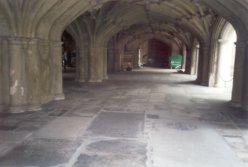
| Vault of Lincoln's Inn Chapel | |||
|
|
|||
|
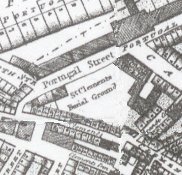
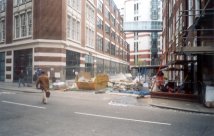
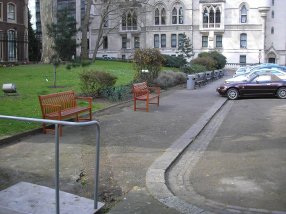
Lost grounds Additional ground, Portugal Street. Established between 1593 and 1609. The King's College Hospital extension was built over it in 1853. All now gone. (See picture of site below.) A notorious ground, and a regular source of corpses for bodysnatchers. In February 1820 three bodies were seen being bundled over the wall. A warrant was issued to search St Thomas's hospital, where the yard and dissecting room 'resembled a slaughter house' with scattered heads, torsos and limbs. The gravedigger and assistant were implicated in the bodysnatching, but were acquitted. (The Times, Feb 18th 1820) For more on the Green Ground see article in The Changing Face of Death Ed Glenys Howarth and Peter Jupp. (Macmillan 1986) This was called the " Green-ground," and was crowded with bodies. A corner of King's College Hospital was built upon the ground. The remaining piece is nearly ½ acre in size, between the hospital and Portugal Street. It is now the entrance drive and a grass plot. It is neatly kept, with some trees and seats in it, and is used solely by the hospital. (Holmes) BURYING GROUND, PORTUGAL STREET.- This ground belongs to the parish of St. Clement Danes ; it is commonly known by the name of the " Green Ground," and has been in use as a burying place beyond the memory of man. The soil of this ground is
saturated, absolutely saturated, with human putrescence. On Saturday the
27th April, 1839, at 5, p.m. I went, accompanied by a friend, to Nos.30
and 31, Clement's Lane, and, upon looking through the windows of the
back attics, we saw two graves open, close to the south-eastern
extremity of this burying ground. Several bones were lying on the
surface of the grave nearest to us-a large heap of coffin wood was
placed in readiness for removal, and, at a small distance, a heap
covered with coarse sacking, was observed, which, when the covering was
taken off, proved also to be long pieces of coffin wood, evidently not
in a decayed state. The nails were very conspicuous. Several basketfuls
of this wood were taken to a building at the south-west extremity of the
ground. We were informed that this sight was by no means a novel one; it
was commonly-almost daily, observed. The cloth covering of the wood
appeared to be nearly as fresh as when interred. The grave diggers were
seen to take off tin plates from the coffins broken up. This desecration
of the grave has not escaped the notice of the passer-by, as is proved
from the following letter to the editor of the Times newspaper, which
was published on the 25th of June last:- SIR, Where this leads to I do not know; but I should be glad, through the medium of your invaluable journal to ask, why is this desecration ? Sir,- I feel more particularly
than many might do, as I have seen twelve of my nearest and dearest
relatives consigned to the grave in that ground; and I felt that,
perhaps, I might at the moment be viewing, in the basket of skulls which
passed before me, those of my own family thus brutally exhumed. The complaint here made is, unfortunately applicable to most of the metropolitan burying grounds, under the present system; a system as dangerous as it is revolting and disgusting: the evil can only be effectually destroyed by an enactment of the Legislature, prohibiting altogether interment within cities, towns, or densely populated villages. The effluvia from this ground,
at certain periods, are so offensive, that persons living in the back of
Clement's Lane are compelled to keep their windows closed; the walls
even of the ground which adjoins the yards of those houses, are
frequently seen reeking with fluid, which diffuses a most offensive
smell. Who can wonder, then, that fever is here so prevalent and so
triumphant ? The workhouse, at the
north-eastern extremity of this ground, has, within the last few weeks,
been disused; and the building, it appears, is about to be converted
into an hospital, for the reception of patients, belonging to the
Medical and Surgical department of King's College: from the high
standing of the gentlemen connected with this establishment, I can
entertain no doubt that the condition of the earth's surface, and,
consequently, the salubrity of the surrounding atmosphere, will be
primary objects of attention before patients are admitted. |
|||
|
HERE LYE THE
REMAINS OF HONEST JO MILLER, FROM RESPECT TO
SOCIAL WORTH, |
|||
|
(1) Many waggon loads were
removed to a receptacle situated on the north east of this ground; some
idea may be formed of the quantity, when I state that five men were
employed about a week in their removal. A part of the buildings of this
hospital stands on ground which, up to about the year 1850, was one of
the burial-places belonging to the parish. It was about the third of an
acre in extent, and called the "Green Ground," as if in
mockery. From a report of a parochial committee in 1848, we learn that
upwards of 5,500 bodies had been interred within it in the previous
quarter of a century. The scenes witnessed here were of the most
offensive character. In it was interred, among other lesser celebrities,
Joe Miller, the author of the "Jest Book" which bears his
name, who died in 1738. A monument was erected to his memory, with an
inscription, said to be by Stephen Duck, who began life as a thresher,
but afterwards entered the Church, and wrote some poems, which incurred
the satire of Dean Swift. This monument, having become decayed and
almost illegible, was renewed in 1816, and is to be seen leaning up
against the wall of one of its offices. The inscription on it ran as
follows:-- Of "Joe Miller" little is known except what may be gathered from his tombstone. Mr. Peter Cunningham, in his "Handbook of London," published in 1850, speaks of Joe Miller’s headstone as standing in the old burying-ground "half concealed in summer by a clump of sunflowers," and draws the special attention of his readers to "the ‘Grange’ public-house, with its old and picturesque inn-yard." It may be remembered that Sir William Davenant, in his "Playhouse to Let," mentions this hostelry in a way which implies that it was a haunt of players. "Let him enter and send
his train to our house-inn, the ‘Grange.’ " But alas! for the
progress of modern improvements, the "Grange" and its yard are
gone. It was taken down in 1853, and its site in now covered by a part
of King’s College Hospital. Kings
College Hospital and its surroundings have obliterated the
recollections and annihilated the grave-stones of the Burial Ground
of St Clement Danes, where Nathaniel Lee, the bombastic dramatist
(1657-1692), author of Sophonisba and Gloriana, was
buried, having been killed in a drunken street brawl.
W.
Chamberlain, grave-digger at St. Clement's, testified that the ground
was so full of bodies that he could not make a new grave "without
coming into other graves." He said: |
|||
|
|
|
||
|
Vault
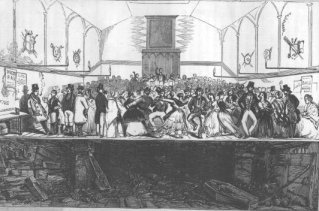
of Enon Chapel, St Clement's Lane. For More on Enon Chapel see Enon: No way for the Dead' in The Changing Face of Death Ed Glenys Howarth and Peter Jupp. (Macmillan 1986) Enon Chapel was opened in April 1822. It was built over an open sewer which passed, presumably uncovered, through the vault. Many writers have been preoccupied with means by which the incumbent, Mr Howse, managed to pack around 12,000 coffins in a space 59 feet by 12 feet (at 15 shillings a time.) It is suggested that the vanishing trick was accomplished by dropping the human remains into the sewer, to float away to the river, and then using the coffin wood as a useful source of timber for cooking and heating the kitchen copper. The coffins could certainly have been used in this way, though whether the sewer would have a sufficient flow to carry body parts to the river without clogging up is questionable. In later years a secret door between the kitchen and the vault was discovered, and large quantities of bones were found under the kitchen floor. Is seems the authorities were suspicious of the goings on at the chapel, and insisted that the sewer be vaulted over, probably in 1834. After this time Howse apparently resorted to quicklime as the means to get rid of the bodies; as mentioned by Bartlett above, vast quantities of human remains were thrown in the river or used as landfill in the district of Waterloo Bridge. The chapel closed in 1844 and was let out for various purposes, including a dance hall for teetotallers, whose events were cheerfully known as 'Dances on the dead'. During 1846/7 Walker leased the chapel and the human remains were moved to Norwood Cemetery, at Walker's expense. Dickens' Encyclopaedia of London records the existence of the chapel (renamed Clare Market Chapel) into the 1890s. Gone by 1914 O.S. Excavations on the site in 1967 prior to the building of a building for the LSE produced large quantities of human bones. ENON CHAPEL.- This building is situated about midway on the western side of Clement's Lane; it is surrounded on all sides by houses, crowded by inhabitants, principally of the poorer class. The upper part of this building was opened for the purposes of public worship about 1823; it is separated from the lower part by a boarded floor: this is used as a burying place, and is crowded at one end, even to the top of the ceiling, with dead. It is entered from the inside of the chapel by a trap door; the rafters supporting the floor are not even covered with the usual defence - lath and plaster . Vast numbers of bodies (1) have been placed here in pits, dug for the purpose, the uppermost of which were covered only by a few inches of earth; a sewer runs angularly across this " burying place." A few years ago, the Commissioners of Sewers, for some cause, interfered, - and ultimately another arch was thrown over the old one; in this operation many bodies were disturbed and mutilated. Soon after interments were made, a peculiarly long narrow black fly was observed to crawl out of many of the coffins ; this insect, a product of the putrefaction of the bodies, was observed on the following season to be succeeded by another, which had the appearance of a common bug (2) with wings. The children attending the SUNDAY SCHOOL, held in this chapel, in which these insects were to be seen crawling and flying, in vast numbers, during the summer months, called them " body bugs," - the stench was frequently intolerable; one of my informants states, that he had a peculiar taste in his mouth during the time of worship, and that his handkerchief was so offensive, that immediately upon his return home, his wife used to place it in water. The parish authorities interfered upon the subject of poor rates, proposing to impose a mere nominal one, if the place were closed; this was done for about twelve months. In defiance of opinion, however, it was again employed for the purposes of interment, and has been so used up to the present time. I am acquainted with many who have been seriously affected by exhalations from the vault, and who have left the place in consequence. Some months since, hand bills were circulated in the neighbourhood, "requesting parents and others to send the children of the district to the Sunday School," held immediately over the masses of putrefaction in the vault beneath. Residents about this spot, in warm and damp weather, have been much annoyed with a peculiarly disgusting smell ; and occasionally, when the fire was lighted in a house abutting upon this building, an intolerable stench arose, which it was believed did not proceed from a drain. Vast numbers of rats infest the houses; and meat exposed to this atmosphere, after a few hours, becomes putrid. This place is familiarly known among undertakers by the appellation of the "Dust Hole," and is a specimen of one of the evils which sprang up during the operation of certain laws that were hostile to the cultivation of anatomical science, which have happily now been repealed. The professed security of the dead was made the pretext; individual advantage was the real object for depositories of this description. The health and comforts of the living were entirely disregarded, and the annoyance and dangers, resulting from the proximity and effluvia of decaying animal substances were submitted to, and hazarded by survivors, rather than subject themselves to the tormenting anxieties which arise from the apprehensions of a brutal exhumation. I have several times visited this Golgotha. I was struck with the total disregard of decency exhibited, - numbers of coffins were piled in confusion -large quantities of bones were mixed with the earth, and lying upon the floor of this cellar (for vault it ought not to be called ), lids of coffins might be trodden upon at almost every step. My reflections upon leaving the masses of corruption here exposed, were painful in the extreme; I want language to express the intense feelings of pity, contempt, and abhorrence I experienced. Can it be, thought I, that in the nineteenth century, in the very centre of the most magnificent city of the universe, such sad, very sad mementos of ignorance, cupidity, and degraded morality, still exist? Possibly I am now treading over the mouldering remains of many, once the cherished idols of the heart's best and purest affections,- here, thought I, may repose one who has had his cares, his anxieties - I who, perchance, may have well fulfilled life's duties, and who has tasted its pleasures and its sorrows, - here he sleeps as I must sleep; yet I could not but desire that I might have a better resting place - a Christian burial. (1) From the most authentic information, I have reason to believe, that since the establishment of this place, from ten to twelve thousand bodies have been deposited here, not one of which has been placed in lead. (2) I have not been able to
obtain a scientific description of these insects. But far worse than the graveyard alluded to above, was another place of burial within the limits of this parish, long known as Enon Chapel, but afterwards converted into a chapel of ease to St. Clement’s, and called Clare Market Chapel. The building stands close to the eastern entrance to Clement’s Inn, and the access to it is through a gateway leading into a narrow and extremely dingy court, which opens out into Carey Street. It was converted from secular to religious uses in 1823, by a Dissenting congregation, of whom Mr. Diprose writes- "These pious people,
looking very naturally to ways and means, turned the vaults beneath
their meeting-house into a burial-place, which soon became filled with
coffins up to the very rafters, so that there was only the wooden
flooring between the living youth and the festering dead, for a
Sunday-school was held in the chapel as well as the congregational
meeting. This state of things was allowed to continue till 1844, when a
new sewer having to be carried under the building, the Commissioners of
Sewers discovered the loathsome charnel-house, and had the place closed,
but left the bodies to lie there and rot, heedless of all consequences.
The upper premises then became tenanted by a set of teetotallers, who,
amongst other uses, turned it into a dancing-room, where the thoughtless
and giddy went to ‘foot it’ away over the mouldering remains of sad
mortality, part of the bygone generation turning to dust beneath the
dancers’ feet." This loathsome abomination ceased in 1847-8, when
a surgeon, Mr. G. A. Walker, gained possession of the chapel with the
intention of removing the remains from the vault, or
"dusthole," as it was usually called, to a more appropriate
place. The work of exhumation was then commenced, and a pyramid of human
bones was exposed to view, separated from piles of coffin wood in
various stages of decay. This "Golgotha" was visited by about
6,000 persons, previous to its removal, and some idea may be formed of
the horrid appearance of the scene, when it is stated that the quantity
of remains comprised four upheaved van loads. The whole mass of bodies
was decently interred by Mr. Walker, at his own cost, in one pit in the
cemetery at Norwood, the coffin wood being piled up and burnt. It is
indeed strange to think that such foul abuses were not swept away until
the reign of Victoria. |
|||
|
|
|||
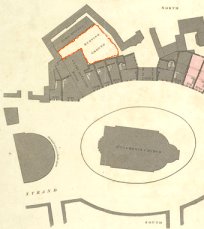
Almshouse Ground, Clements Lane. This map of c 1800 shows the almshouse ground (marked in red) south of the row of almshouses and north of other buildings, presumably shops. A cheery outlook for the residents. According the The Times the ground did not come into use until 1802. It is now part of the open space to the west of the Law Courts. At the bottom - the south end - of this Lane, is another burying place, belonging to the alms houses, within a few feet of the Strand. This place is, I believe, filled with dead; many of the coffins being near the surface. (Walker 1839) |
|||
|
|
|
||
|
Rolls Chapel In the Liberty of the Rolls, since 1922 part of Westminster. Despite much protest, the much rebuilt medieval chapel was largely demolished in 1895 and replaced with a new building on the site. Some of the monuments were kept, though Mrs Holmes tells us that the vault (containing the remains of the disgraced speaker John Trevor, amongst others ) disappeared at this time. I have seen reference to a small burial ground somewhere near, but have no hard information. |
|||
|
|
|||